

When the world won't sit still

Physiotherapist and founder of Heads Up Concussion Care, Complete Concussions Certified
If you feel dizzy, unsteady, or overwhelmed in busy places since your concussion, or reading and screens have become a struggle, your vestibular and visual systems may be involved. These are some of the most common, and most treatable, causes of persistent symptoms.
What controls your balance?
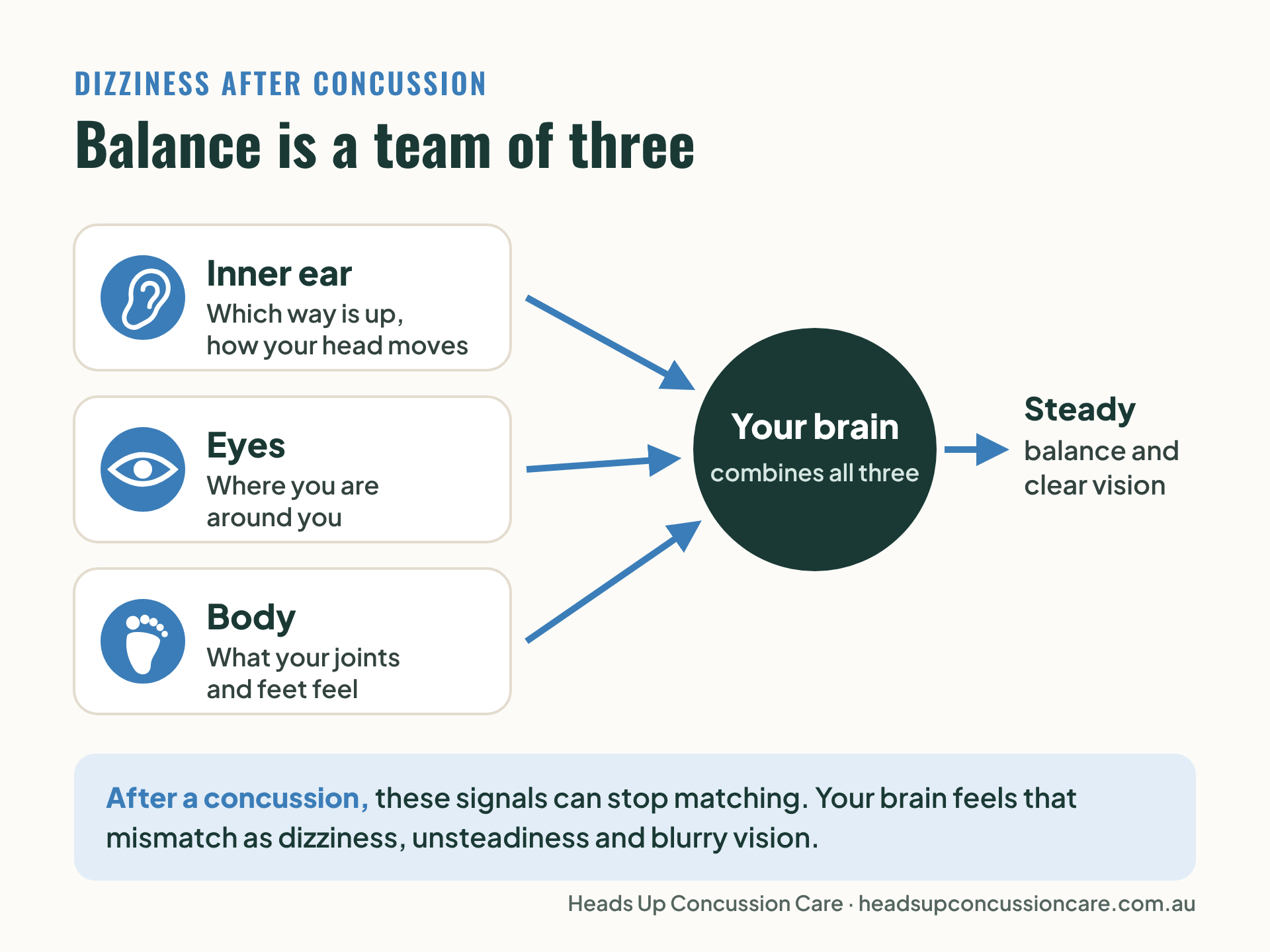
Staying balanced and seeing clearly is a team effort between three systems:
- Your inner ear (vestibular system). Deep inside each ear is a tiny sensor that works like a built-in spirit level. It tells your brain which way is up and how your head is moving.
- Your eyes. They tell your brain where you are in relation to everything around you.
- Your body. Sensors in your joints, muscles and feet tell your brain where your body is and what it's standing on.
Your brain combines all three signals into one clear picture. It also uses your inner ear to keep your vision steady while your head moves, a bit like the stabiliser on a camera. That's why you can read a sign while walking without the words bouncing around.
Why do you feel dizzy after a concussion?
A concussion can disrupt how these systems talk to each other. When the signals from your inner ear, eyes and body don't match, your brain struggles to make sense of them. That mismatch shows up as symptoms.
Imagine three people giving you directions at once, all slightly different. You'd feel confused, slow and overwhelmed. That's what your brain is dealing with.
Your neck can feed into this too, as it also sends balance signals to your brain. Neck pain and headaches after concussion explains how. If your dizziness gets worse when you exercise, read about exercise intolerance after concussion.
Common vestibular and vision symptoms after concussion
- Dizziness, especially with quick head movements or turning over in bed
- Feeling unsteady, off-balance or "floaty"
- Blurry or jumpy vision
- Trouble reading, losing your place on the page, or struggling with screens
- Feeling overwhelmed in busy places like shopping centres, supermarkets or crowds
- Nausea or motion sickness, including in the car
- Headaches or fatigue after visual tasks
Many people stop going to busy places because they feel so bad there. However, avoiding them can keep symptoms going for longer.
How are vestibular problems assessed?
At Heads Up Concussion Care in Perth, we test how well your eyes track and focus, how your eyes and inner ear work together when your head moves, and how well you balance in different conditions. This pinpoints which parts of the system need work, so treatment can be targeted rather than generic.
How does vestibular rehab work?
The vestibular system responds well to rehab. Like any training, it gets better with practice.
Retraining eye movements. Specific exercises help your eyes track, focus and switch between targets more efficiently, which can make reading and screens easier.
Gaze stabilisation. Exercises that keep your eyes fixed on a target while your head moves help retrain the "camera stabiliser" between your inner ear and eyes.
Balance training. We progress from simple to more challenging balance tasks, adding head movements, different surfaces or eyes closed, and additional cognitive tasks, to rebuild your body's confidence.
Gradual exposure. We slowly build your tolerance to movement and busy environments, so places that used to overwhelm you become manageable again. The key is the right dose: enough to challenge your system, but not so much that symptoms flare for hours.
Referral if needed. If your assessment shows a vision issue that needs specialist care, we'll refer you to an optometrist with an interest in concussion.
A tip for home
If symptoms flare during an exercise, that's not necessarily a bad thing. A mild rise that settles within an hour usually means your brain is being challenged in a helpful way. If symptoms jump a lot or don't settle, ease back and let your physio know.
The takeaway
Dizziness and visual problems after concussion can be frustrating and isolating, but they're very treatable. With the right exercises, at the right level, most people steadily regain their balance, their confidence and their ability to enjoy busy places again.
Call 000 or go to emergency if you have a severe or worsening headache, repeated vomiting, a seizure, weakness, or increasing confusion. Healthdirect lists these warning signs. Heads Up is a day clinic in Subiaco, not an emergency service.
Don't wait to see if it settles on its own. Getting assessed early, ideally within the first few days after your concussion, gives you the best chance of a smooth recovery and lowers the risk of symptoms hanging around. Even in the early days, it's worth getting checked properly.
Want to learn more? See our concussion services, meet the team, or start with what a concussion actually is.
Book an appointment for a concussion assessment. No referral is required.
Trusted resources (Australia)
Common questions
- How long does dizziness last after a concussion?
- For many people it settles within a few weeks. If it lasts longer, the vestibular system is often involved and responds well to targeted rehab.
- Why do I feel worse in shopping centres after a concussion?
- Busy, visually crowded places overload a balance system that's struggling to combine signals from your eyes, inner ear and body. This is very treatable through targeted rehabilitation and gradual exposure to busier environments.
- What is vestibular rehabilitation?
- It's a set of targeted exercises that retrain your balance and eye movements so your brain can process movement and busy environments again.
- Where can I get vestibular rehab in Perth?
- Heads Up Concussion Care in Subiaco provides vestibular assessment and rehab for concussion-related dizziness.