

When your body's stuck in fight-or-flight

Physiotherapist and founder of Heads Up Concussion Care, Complete Concussions Certified
If you've had a concussion and still feel "wired but tired", feel heart rate racing at rest, or find your symptoms flare the moment you exercise, your autonomic nervous system may be part of the picture. It's one of the most common drivers of persistent post-concussion symptoms. It's also one of the most treatable.
What is the autonomic nervous system?
Your autonomic nervous system runs everything your body does on autopilot. Heart rate, blood pressure, breathing, digestion and body temperature all happen without you having to think about them.
It has two main divisions. The sympathetic nervous system is your fight-or-flight system, which gets your body ready for action. The parasympathetic nervous system is your rest-and-digest system, which calms your body down so it can recover.
It's easiest to picture it as a car with two pedals:
- The accelerator is your sympathetic nervous system. It's your fight-or-flight mode, speeding up your system so it's ready for action, with your heart rate up and your body on alert.
- The brake is your parasympathetic nervous system. It's your rest-and-digest mode, calming things down so your body can recover, digest and sleep.
In a healthy system, your body switches smoothly between the two all day. You speed up when you need to and slow down when you don't.
Why do symptoms get worse with exercise after a concussion?
A concussion can disrupt the parts of the brain that control this balance. The accelerator can get stuck down while the brake barely works. Your body stays revved up even when it should be resting. We call this autonomic dysregulation.
When your system is stuck in this state, ordinary things can feel like hard work. A walk up the stairs, a light gym session or a long day at work can push your heart rate and symptoms higher than they should. This is often called exercise intolerance. It's not in your head, and it's not a sign of weakness. Your body's control system simply hasn't recalibrated yet.
Signs your autonomic nervous system is involved
Everyone's different, but common signs include:
- Headache, dizziness or fogginess that flare with exercise or physical effort
- A racing or pounding heart, sometimes at rest
- Feeling light-headed or dizzy when you stand up
- Feeling "wired but tired": exhausted, yet unable to switch off
- Trouble falling asleep or staying asleep
- Feeling hot, sweaty or flushed more easily than usual
- Changes in digestion
- Feeling anxious or on edge for no clear reason
If several of these sound familiar, it's worth getting assessed.
How is exercise intolerance assessed? The Buffalo concussion treadmill test
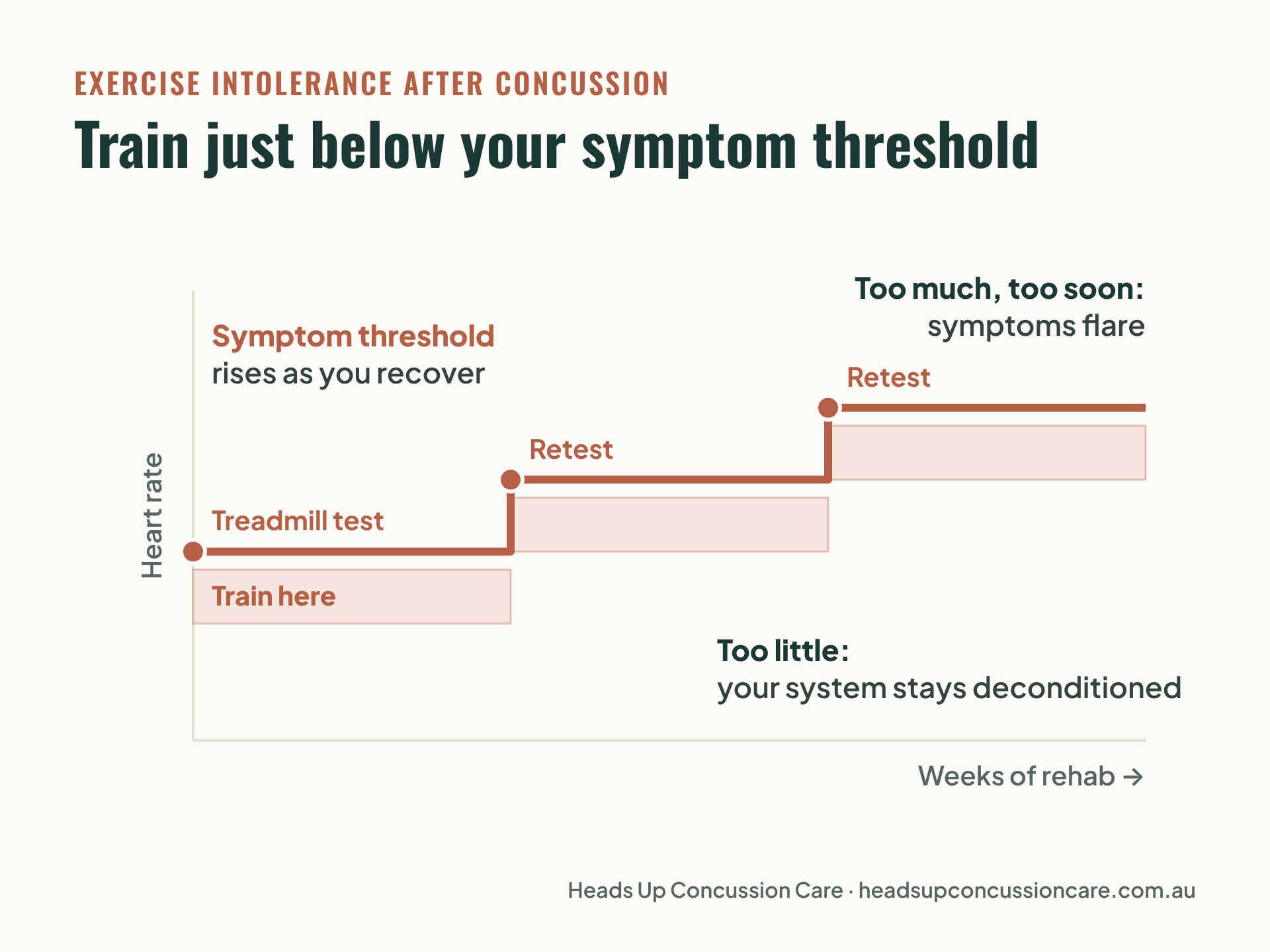
At Heads Up Concussion Care in Perth, a key part of your assessment is the Buffalo concussion treadmill test. You walk on the treadmill while we gradually increase the effort by increasing the inclination of the treadmill, you walk up a progressively steeper hill. We monitor your heart rate and symptoms throughout and note when symptoms start to rise. That point is your symptom threshold.
This tells us two things. It shows whether your autonomic system is part of the problem, and it gives us a safe, personalised heart rate target to start your rehab from.
How is it treated?
The good news is that the autonomic nervous system responds well to the right kind of training.
A carefully measured aerobic exercise program. Using your treadmill test result, we set a heart rate target just below the point where your symptoms build. Exercising regularly at this level helps retrain how your heart and nervous system respond to effort. As your tolerance improves, we repeat the test and increase your target. Gradually, your body relearns how to handle more.
This is very different from "pushing through" or from complete rest. Too much too soon can flare symptoms. Too little keeps your system deconditioned. The sweet spot is measured, consistent and progressive.
Finding the brake again. Alongside exercise, we teach techniques that switch on your rest-and-digest system. Slow, controlled breathing is one of the most effective. We often prescribe box breathing: breathe in through your nose for 4 seconds, hold for 2, breathe out through your mouth for 4, then hold for 2. Repeat for 10 to 15 cycles. Mindfulness and meditation can help too.
Supporting the basics. Good sleep routines, regular meals, staying hydrated and pacing your day all reduce the load on your system while it recovers.
The takeaway
If your body feels stuck in overdrive after a concussion, there's usually a reason, and there's usually a plan. Autonomic dysregulation is common, it can be measured, and it can be retrained. With the right approach, most people find their tolerance steadily improves and they get back to the things they love.
Call 000 or go to emergency if you have a severe or worsening headache, repeated vomiting, a seizure, weakness, or increasing confusion. Healthdirect lists these warning signs. Heads Up is a day clinic in Subiaco, not an emergency service.
The Australian Institute of Sport concussion guidelines support a gradual return to activity rather than prolonged rest.
Don't wait to see if it settles on its own. Getting assessed early, ideally within the first few days after your concussion, gives you the best chance of a smooth recovery and lowers the risk of symptoms hanging around. Even in the early days, it's worth getting checked properly.
Want to learn more? See our concussion services, meet the team, or start with what a concussion actually is.
Book an appointment for a concussion assessment. No referral is required.
Trusted resources (Australia)
Common questions
- Should I rest or exercise after a concussion?
- After the first day or two, gentle, measured exercise below your symptom threshold usually helps recovery more than complete rest.
- Why does my heart race after a concussion?
- Concussion can disrupt the autonomic nervous system, leaving your fight-or-flight response switched on more than it should be.
- What is the Buffalo concussion treadmill test?
- It's a graded treadmill test that finds the heart rate at which your symptoms start to rise, so your exercise program can be set safely below it.
- Where can I get a concussion treadmill test in Perth?
- Heads Up Concussion Care in Subiaco offers treadmill testing as part of a full concussion assessment.