

The invisible injury, explained

Physiotherapist and founder of Heads Up Concussion Care, Complete Concussions Certified
A concussion is often called an "invisible injury". There's no cast, no stitches, and scans usually come back normal. But inside your brain, a lot is going on. Understanding what's happening, and when, is one of the best ways to recover well and stay safe.
What happens in your brain during a concussion?
When a force to your head or body makes your brain move and stretch rapidly inside your skull, brain cells are suddenly thrown off balance. Chemicals rush in and out of the cells, and they fire off a huge burst of activity all at once.
To restore order, your brain cells need a lot of energy. But at the same time, blood flow to the brain drops, so less fuel is getting through. More demand, less supply. We call this the energy crisis.
Think of it like your phone. Something triggers dozens of apps to open at once, draining the battery fast, while the charger has been unplugged. The phone still works, but it's slow, glitchy and goes flat quickly.
Can concussion symptoms be delayed?
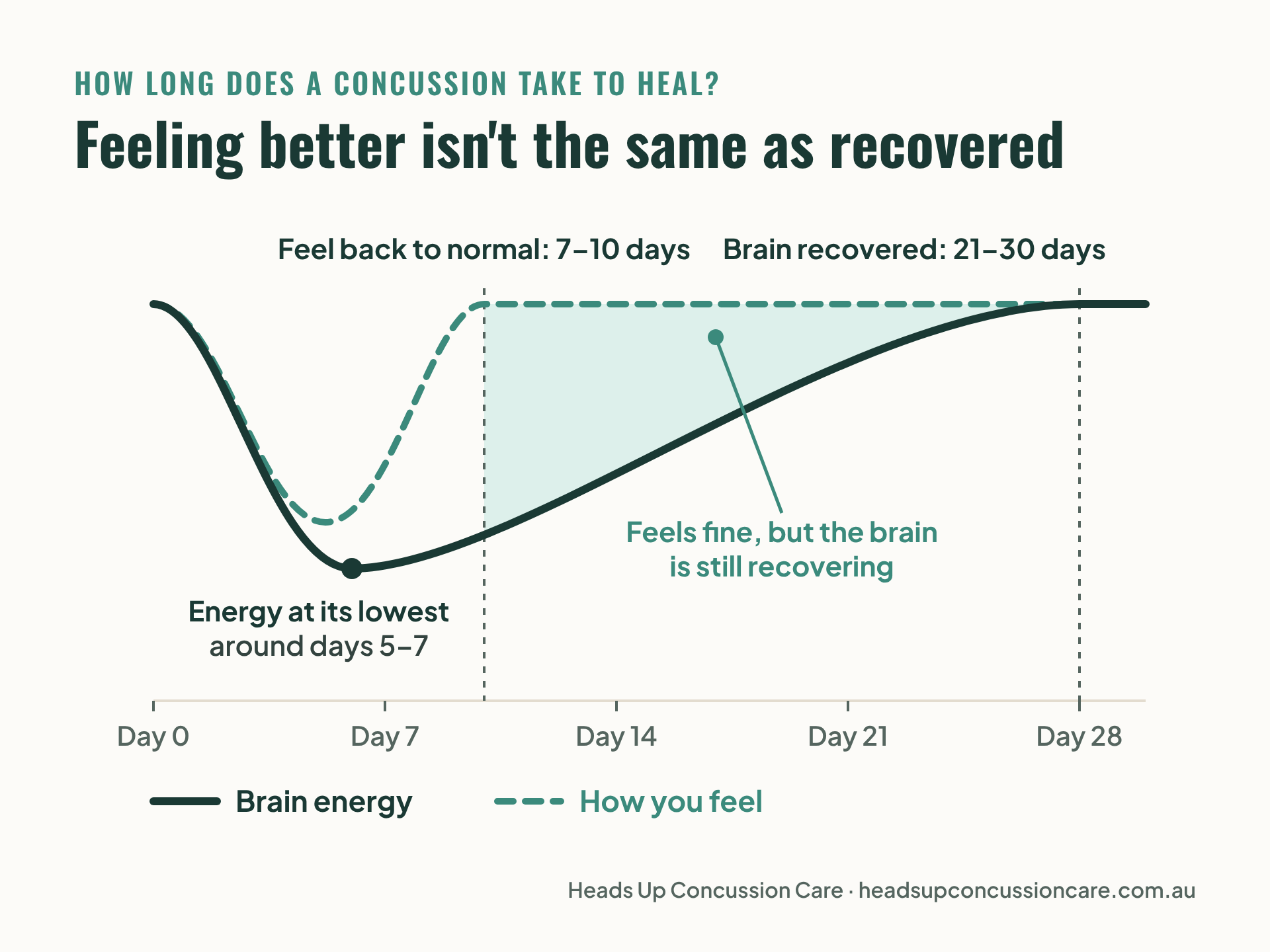
Yes. The energy crisis doesn't peak at the moment of impact. Energy levels keep falling for days afterwards. On average, they hit their lowest point around 5 to 7 days after the injury.
This is why many people don't realise they're concussed in the moment. You might finish the game, drive home or go to work feeling fine, then wake up the next day with a headache, fog or nausea. This is known as a delayed concussion, and symptoms can appear up to 72 hours after the injury. If you've had a knock, keep an eye on how you feel over the next few days, not just the first few minutes.
How long does a concussion take to heal?
In a standard, uncomplicated concussion, your brain's energy levels begin to return to normal around 21 to 30 days after the injury.
Here's the good news: most people feel back to themselves, and symptom-free, much sooner than that, often around 7 to 10 days after the injury.
But that good news hides a real danger.
Why feeling better doesn't mean your brain has healed
Research consensus is clear that symptoms settle before the brain has fully recovered. You can feel 100% while your brain's energy levels are still well below normal.
Think of a sprained ankle. A week later, the swelling's gone and it doesn't hurt to walk. But the ligament is still healing and nowhere near its full strength. Roll it again on the footy field and the damage is far worse than the first time, because you've injured something that was already weak.
The brain works the same way. Between feeling better (around 7 to 10 days) and actually being recovered (around 21 to 30 days), there's a window where your brain is still vulnerable.
Why the 21-day rule exists
This is why the Australian Institute of Sport (AIS), along with most Australian sporting bodies, now recommends a minimum of 21 days from the time of a concussion before returning to competitive contact sport. You also need to be symptom-free for at least 14 days before going back to contact training.
The 21-day mark lines up with the time the brain's energy levels usually take to recover. The rule protects you through the window when a second knock can do the most damage. Around 30 Australian sports, including the AFL, have adopted it for youth and community sport.
Why is a second concussion so dangerous?
If you have a second concussion before your brain has recovered from the first, the effects don't simply add together. They multiply. Your brain is already running on a depleted battery, so a second energy crisis hits much harder.
A second concussion during this window can cause a far deeper energy crisis and much greater damage to brain cells, some of which may not fully recover. Instead of weeks, recovery can take months.
This is exactly why we don't base return to sport, or other high-risk activities, on symptoms alone. Feeling good is a great sign, but it isn't the finish line.
What should you do after a concussion?
- Take a knock seriously, even if you feel fine at first. Watch for symptoms over the next 72 hours.
- Don't rush back to contact sport just because your symptoms have gone. Follow a structured, staged return with your clinician.
- If symptoms last longer than a month, that's a sign other body systems are involved. These can be assessed and treated.
- Get assessed early. See a healthcare professional with concussion experience as soon as possible after the injury, and before your final return-to-sport clearance.
The brain is remarkably good at healing when it's given the right conditions and the right amount of time. At Heads Up Concussion Care in Perth, our job is to help you through that process safely, so you come back stronger, not sooner.
Call 000 or go to emergency if you have a severe or worsening headache, repeated vomiting, a seizure, weakness, or increasing confusion. Healthdirect lists these warning signs. Heads Up is a day clinic in Subiaco, not an emergency service.
Want to learn more? See our concussion services, meet the team, or start with what a concussion actually is.
Book an appointment for a concussion assessment. No referral is required.
Trusted resources (Australia)
Common questions
- How long do concussion symptoms last?
- Most people feel back to normal within 7 to 10 days, but the brain usually takes around 21 to 30 days to recover fully. Symptoms lasting more than a month are called persistent post-concussion symptoms.
- Can you have a concussion and not know it?
- Yes. Symptoms can be delayed by up to 72 hours, so you may feel fine straight after the knock.
- When is it safe to return to sport after a concussion?
- Not as soon as symptoms go. Australian guidelines recommend a minimum of 21 days from the injury before returning to competitive contact sport, while following a progressive, staged return-to-sport plan guided by a clinician. That's because the brain is still vulnerable after symptoms settle.
- Where can I get concussion treatment in Perth?
- Heads Up Concussion Care in Subiaco is an accredited Complete Concussions clinic offering assessment and rehab for concussion and persistent symptoms.